UI/UX Design in Indianapolis
UI/UX Design Services We Provide
Six design services for Indiana businesses building or fixing software.
UX Research & Discovery
Interviews, user flows, and journey maps that show how people actually use your product.
UI Design
Layout, type, color, and components designed for clarity on every screen.
Interactive Prototyping
Clickable prototypes your team can test before a line of code is written.
Design Systems
Reusable component libraries that keep every screen consistent as you grow.
Usability & Accessibility
Usability testing and WCAG accessibility reviews that catch problems before launch.
App & Website Redesign
UX audits and phased redesigns that fix what's failing without a full rebuild.
When Professional UI/UX Design Is Worth It — and When It Isn't
Design work is the right investment for some software and overkill for other software. Here's how we tell the difference — before you commission anything.
When you can skip it
- A small internal tool with a handful of trained users
- A proven workflow that rarely changes
- An existing design system already covers the screens
- Captive users and low stakes
When it's worth it
- A customer-facing product where adoption drives revenue
- Complex workflows users struggle to finish
- Screens built ad hoc, inconsistent page to page
- Users can leave — churn and abandonment show it
Software Design Built Around Your Users
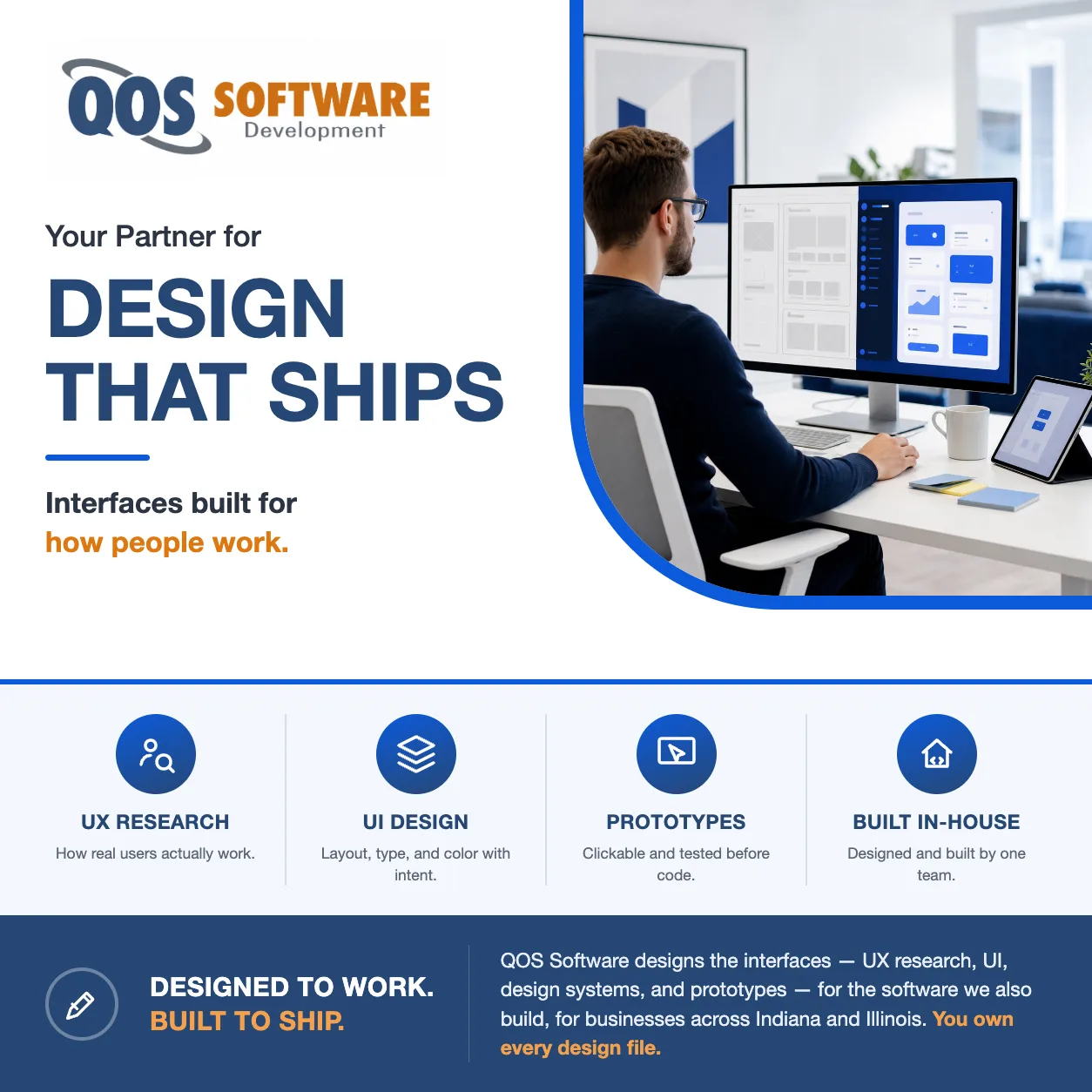
QOS Software provides UI/UX design services — UX research, interface design, design systems, interactive prototypes, and usability and accessibility reviews — for companies in Indianapolis, across Indiana, and in the Chicago metro. Design and development live under one roof, so the interfaces we design actually get built.
We design from evidence, not taste. Before we choose a layout, we learn how your users actually work — what they’re trying to finish, where they get stuck, and what they ignore. The interface follows those findings, so the product feels obvious to the people who use it every day.
UI/UX design is one focus of our broader custom software development practice. Because the same team designs and builds, nothing gets lost in an agency-to-developer handoff — the screens we hand over are ones we can actually ship.
And you keep everything. Every deliverable — the design files, the design system, the research — is yours outright, so you can build with us, take it to another developer, or maintain it in-house without starting over.
What Is UI/UX Design?
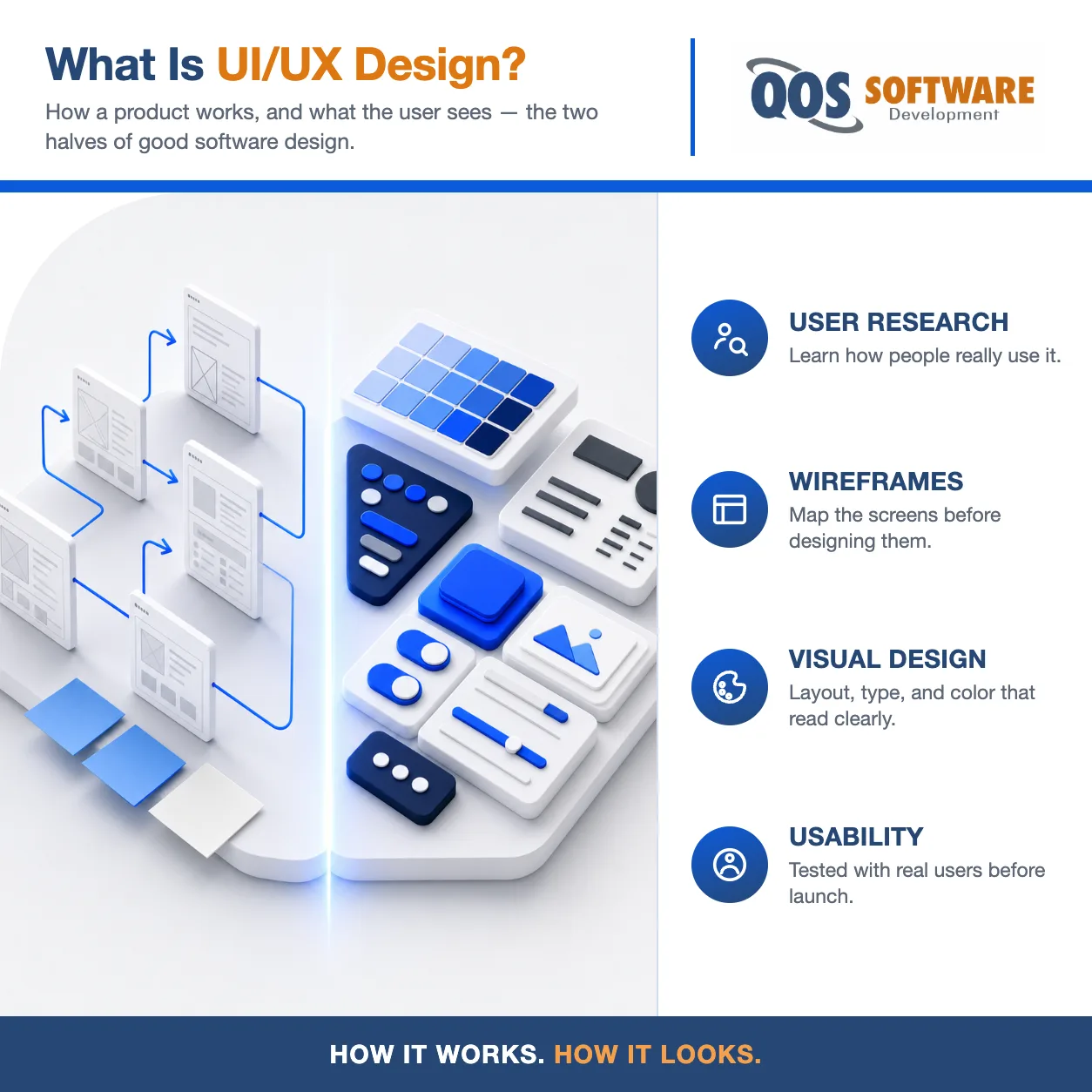
UI/UX design is the discipline of shaping how a software product works and how it looks, so people can use it easily. UX — user experience — is how the product works: the research, user flows, and structure behind every screen. UI — user interface — is what the user sees: the layout, type, color, and components on screen. Good software needs both, designed together.
- User research and interviews
- Wireframes and user flows
- Interactive prototyping
- Visual (UI) design
- Design systems and component libraries
- Usability testing
- Accessibility (WCAG) review
- Developer handoff and design QA
Why Indianapolis Businesses Choose QOS Software for UI/UX Design
Plenty of studios can make screens look good. Fewer design from real evidence, tell you when research isn't needed, and can actually build what they draw.
- Design and development under one roof — buildable designs, no handoff gap
- Evidence over taste — research and usability findings drive decisions
- AI-assisted design and development that moves faster
- You own every design file and research finding outright

Design Assets You Own
When a design engagement ends, everything we made is yours — not files locked inside an agency's account that you have to license back.

- The design source files (Figma)
- The design system and component library
- Research findings and personas
- Interactive prototypes
- Accessibility review reports
- Developer handoff specs
Design-First vs. Straight-to-Build: When Each Wins
When design-first pays off — and when going straight to build is the right call.
| Factor | Design-First | Straight-to-Build |
|---|---|---|
| Best fit | Customer-facing products where usability drives adoption | Small internal tools with trained, captive users |
| Rework risk | Problems caught in prototypes, before they’re coded | Problems surface after the build, when they cost most to fix |
| User adoption | Tested with real users before launch | Judged only after launch, once users are already in it |
| Stakeholder alignment | Everyone signs off on a clickable prototype first | Alignment happens later, on working software |
| Speed to first working version | Slower — design comes before the first code | Faster to a first version you can click |
Where We Design Software
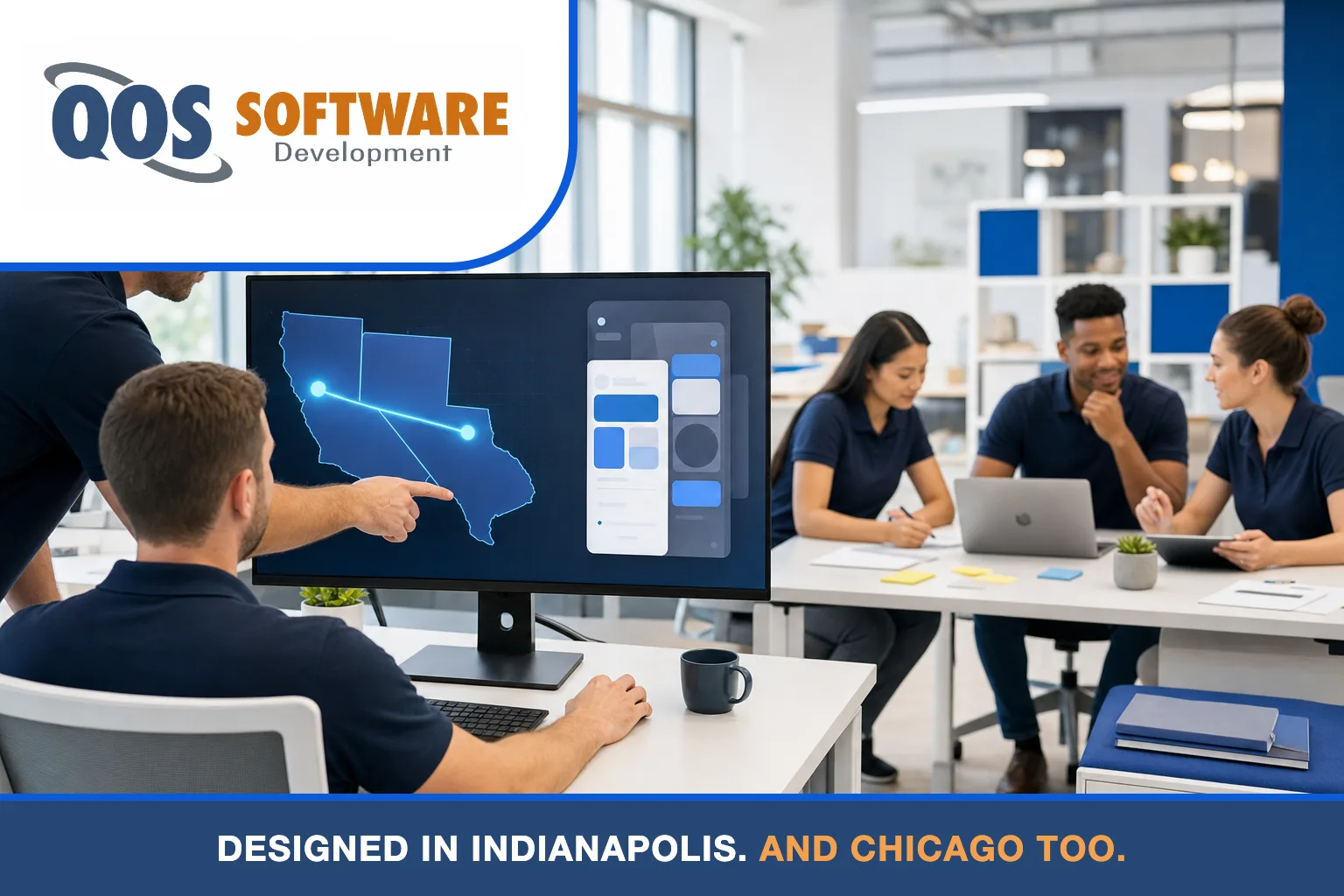
We design software for businesses in two metros and deliver to clients nationwide. Indianapolis and Central Indiana are home; the Chicago metro and Northern Illinois are our growing second market.
- Indianapolis and Central Indiana businesses
- Chicago metro and Northern Illinois companies
- Remote and on-site engagements across both states
- Nationwide clients who need a dedicated design partner

Download the UX Redesign Checklist
Thinking about redesigning an app or website? Before you commission anything, there are questions worth answering — what's actually failing and how you know, real user complaints versus stakeholder taste, which workflows to test first, and when not to redesign at all. This free checklist walks you through them, so you spend the budget where it counts.
Frequently Asked Questions About UI/UX Design
-
What is the difference between UI design and UX design?
UX design — user experience — is how a product works: the research, user flows, and structure that decide what goes where and why. UI design — user interface — is what the user sees: the layout, colors, typography, and interactive components on each screen. UX makes the product usable; UI makes it clear and consistent. Most software needs both, and at QOS Software the same team handles them together.
-
When does a business need UX research, and when is a UI refresh enough?
You need UX research when users can leave, when workflows are complex, or when you don't yet know why people struggle with your product — research answers questions your team can't answer from the inside. A UI refresh is enough when the workflow already works and users are trained and captive, like a small internal tool; there, a clean, consistent interface pass delivers most of the value without a full research engagement. We tell you which one your project actually needs.
-
Can you redesign an existing application without rebuilding it?
Yes. Many products don't need a rebuild — a UX audit plus a design-system pass can fix inconsistent screens, confusing flows, and accessibility gaps while the existing application keeps running, and we can phase the work screen by screen so the software stays usable throughout. When the problems turn out to be deeper architectural ones, that becomes a development project, and our web application development team leads the build.
-
Who owns the design files and research from a UI/UX project?
You do. With QOS Software, the client owns every design deliverable outright — the source design files, the design system and component library, research findings and personas, prototypes, and developer handoff specs. There's no lock-in: you can hand the files to any developer, in-house or outside, and they'll have everything needed to build or maintain the product.
-
Does QOS Software use AI in its UI/UX design process?
Yes — we use AI to assist and accelerate our own design and development work, from synthesizing research to generating and testing interface variations faster. We do not sell standalone AI products, though; AI agents, automation, and LLM-driven workflows are built by our sister company, QOS Agentic (qosagentic.com). If your project needs a standalone AI product, we'll point you to the right team.
-
Does QOS Software build the software after designing it?
Yes. Design and development live under one roof at QOS Software, so the same team that designs your interface can build it — no agency-to-developer handoff gap where intent gets lost. Web applications are our core build practice (web application development); for mobile apps or online stores, ask about mobile app development and e-commerce development. Either way, you own the design files and the finished software.