API Integration in Indianapolis
Core API & Integration Services We Provide
Six ways we connect the systems Indiana businesses run on.
Custom API Development
Custom REST and GraphQL APIs that let your applications share data and trigger actions securely.
Third-Party Integrations
Connect the CRM, accounting, and ERP tools you already run so data moves without re-keying.
Middleware & Custom Connectors
Custom middleware and connectors that bridge systems no off-the-shelf integration supports.
Data Sync & ETL
Automated data sync and ETL pipelines that keep every system working from the same numbers.
Legacy System Connectors
Connectors that let modern software read from and write to legacy and on-premise systems.
Webhooks & Integration Monitoring
Event-driven webhooks with monitoring that catches, logs, and retries failed transfers.
When Custom Integration Is Worth It — and When It Isn’t
An off-the-shelf connector is genuinely enough for many workflows — and we’ll say so. Here’s how we tell when it isn’t, before you spend anything.
When off-the-shelf is enough
- One simple trigger-and-action workflow
- Both tools already have native connectors
- Low volume with no custom logic
- Nothing critical rides on a silent failure
When custom integration wins
- Multi-step logic a connector can’t express
- No connector exists for a niche or legacy system
- High volume that per-task pricing punishes
- Failures must be caught, logged, and retried
Systems That Finally Talk to Each Other
QOS Software builds custom APIs and system integrations — REST and GraphQL APIs, third-party software connections, middleware, and automated data sync — for companies in Indianapolis, across Indiana, and in the Chicago metro. Every integration ships with full source-code ownership: no per-connector subscription, no vendor lock-in.
Most businesses don’t have a software problem — they have a systems-that-don’t-talk problem. Your CRM doesn’t know what your accounting system knows, someone re-keys the same order into three tools, and reports are stale by the time they’re built because the numbers live in five places. Integration removes the swivel-chair work: the systems exchange data on their own, and everyone works from the same information.
API integration is one focus of our broader custom software development practice. Our enterprise team builds the back-end systems, our web app team builds the apps, and this is the work that makes them talk to each other — and to every third-party tool you run.
Every connection we build is handed over with its source code, documentation, and a credentials map, so you can change it, extend it, or move developers later without being locked into us or a per-connector subscription.
What Is an API Integration?
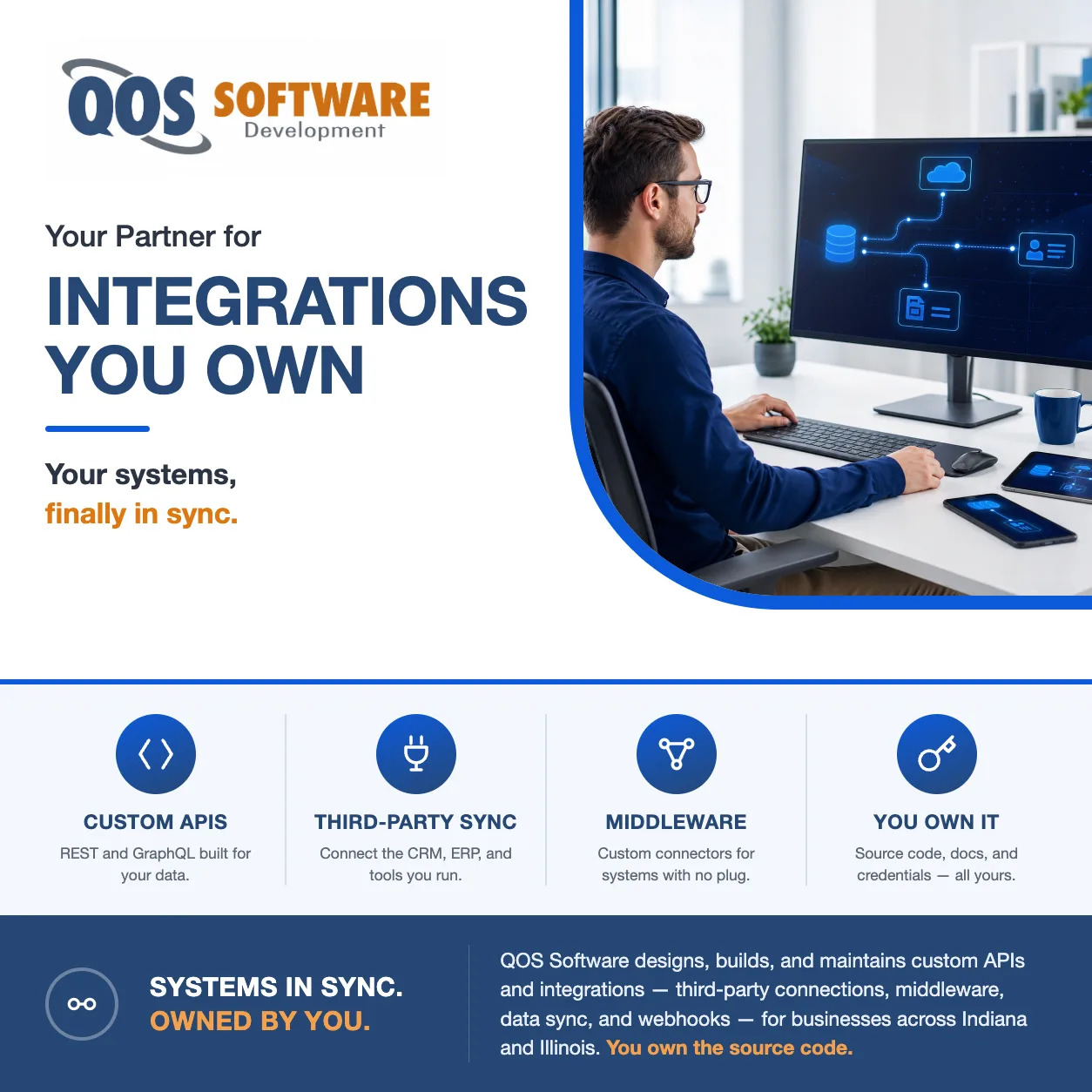
An API integration is a software connection that lets two or more applications exchange data and trigger actions automatically, using each system’s application programming interface (API). An API is the doorway a system opens for other software to use; an integration is the traffic that actually moves through it. In short: the API is the connection point, and the integration is the working data flow you build on top of it.
- REST and GraphQL API design
- Third-party software connections
- Middleware and custom connectors
- Automated data sync and ETL
- Webhooks and event-driven updates
- Integration platform (iPaaS) setup
- API authentication and security
- Integration monitoring and error handling
Why Indianapolis Businesses Trust QOS Software with Integrations
Anyone can wire two tools together with a connector. Fewer will tell you when you don’t need custom work, build integrations you actually own, and still be there when a vendor changes an API two years from now.
- Senior developers who build systems, not just glue
- Honest scoping — we recommend off-the-shelf when it fits
- AI-assisted development that ships faster and lowers cost
- Everything documented and handed over — code, credentials, runbook
Integrations You Own
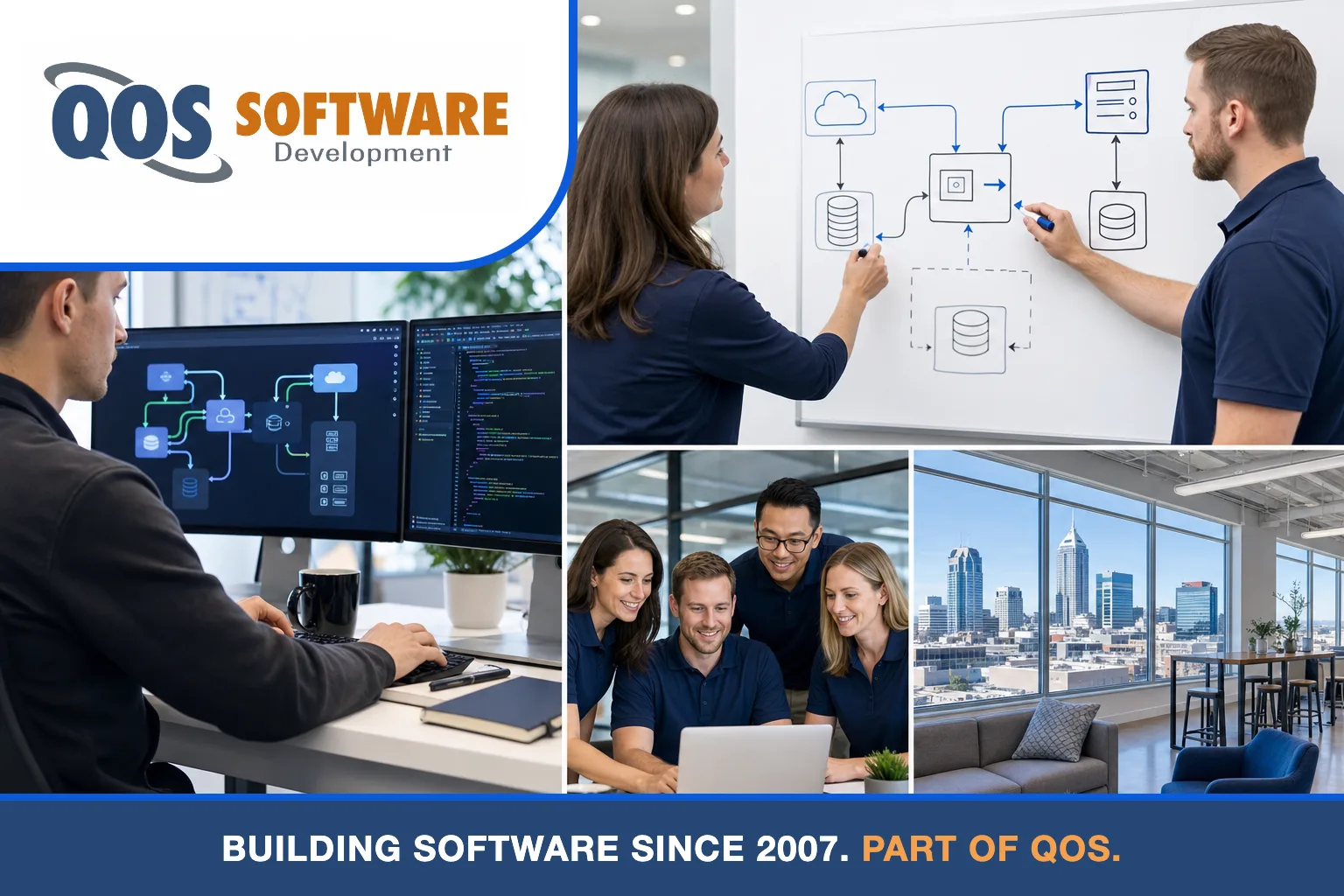
The difference between building and renting is ownership. When we finish, the integration is yours — the code, the documentation, and the credentials — not a subscription you pay us to keep running.

- The full source code, outright
- All documentation and the credentials map
- Your data and how it flows between systems
- The freedom to extend or re-point it anytime
- The freedom to change developers anytime
- No per-connector or per-task subscription
Custom Integration vs. Off-the-Shelf iPaaS: When Each Wins
Where a custom integration pays off — and where a connector like Zapier is enough.
| Factor | Custom Integration | Off-the-Shelf iPaaS |
|---|---|---|
| Fit & complexity | Handles multi-step logic and rules a connector can’t express | Great for simple, standard trigger-and-action workflows |
| Ownership | You own the code, credentials, and data flow outright | You rent access; the platform owns the connection |
| Cost structure | A one-time build you own — no per-task metering | Ongoing subscription, often priced per task or per run |
| Data volume & control | Built for high volume with full control over your data | Task limits and rate caps can throttle it at scale |
| Error handling & reliability | Errors caught, logged, and retried on your rules | Retries and alerts limited to what the platform offers |
Where We Build APIs & Integrations
We build APIs and integrations for businesses in two metros and ship to clients nationwide. Indianapolis and Central Indiana are home; the Chicago metro and Northern Illinois are our growing second market.
- Indianapolis and Central Indiana businesses
- Chicago metro and Northern Illinois companies
- Remote teams and on-site engagements across both states
- Nationwide clients who need a dedicated integration partner

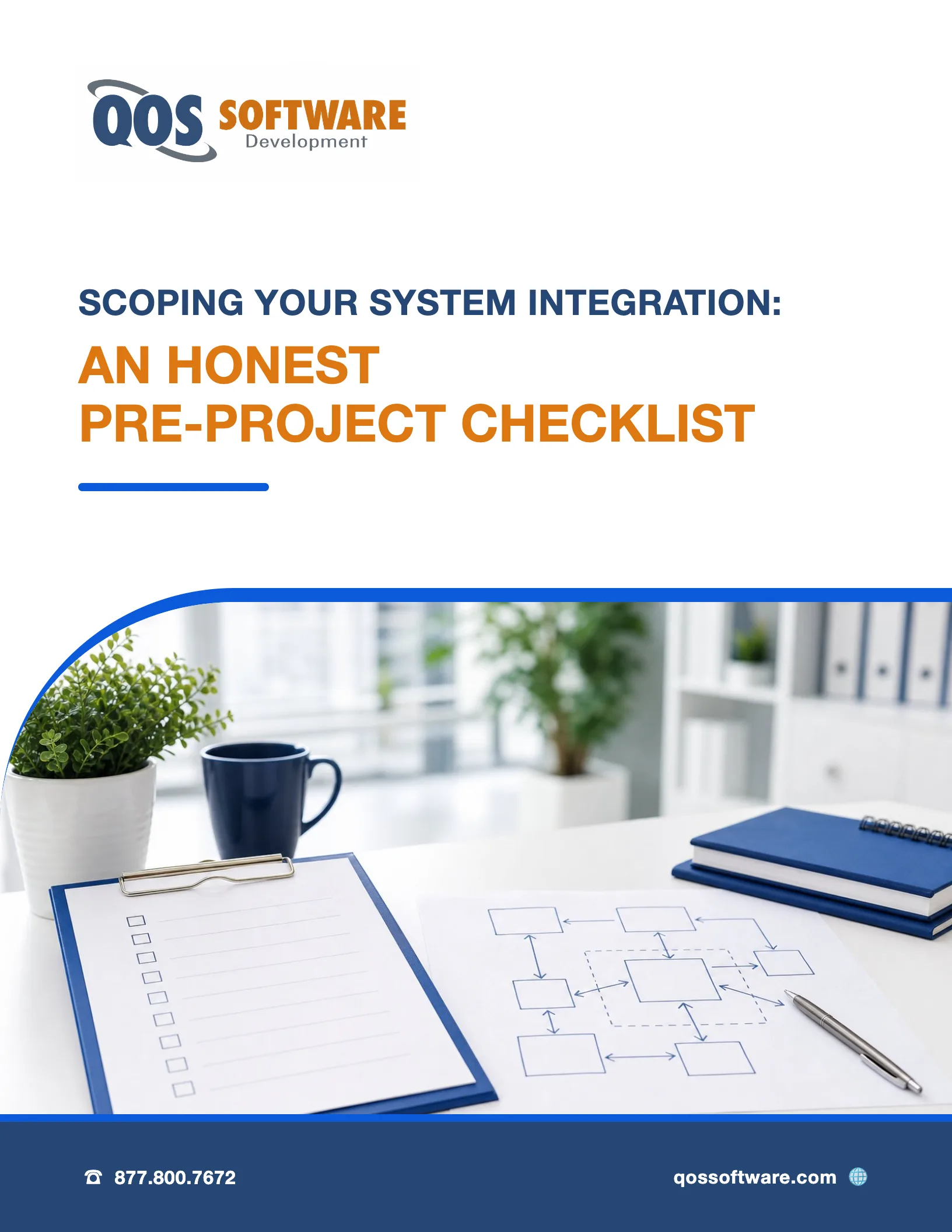
Download the Integration Planning Checklist
Before you commission an integration, there’s a short list of questions worth answering — about which systems you’re connecting, which way the data flows, how much of it, how you’ll authenticate, and what happens when something fails. This free checklist walks you through them, so you scope the project clearly and skip the expensive surprises that come from not asking.
Frequently Asked Questions About API Integration
-
What is an API integration?
An API integration is a software connection that lets two or more applications share data and trigger actions automatically, through each system’s API. Instead of someone copying information from one tool into another by hand, the systems talk directly — an order in your store updates your accounting, a new lead flows into your CRM — on their own, in near real time.
-
When is an off-the-shelf connector like Zapier enough, and when do I need custom integration?
An off-the-shelf connector like Zapier, Make, or Power Automate is enough when you’re linking a simple trigger to a simple action, both tools already offer solid native connectors, and the volume is low. You need custom integration when the logic runs more than one step, no connector exists for your system, per-task pricing gets expensive at volume, or a silent failure would cause real problems. We’ll tell you honestly which one your case calls for — sometimes the answer is “just use Zapier.”
-
How long does an API integration project take?
Integration timelines run by scope, not a fixed number. Connecting two systems that both have solid APIs can take a couple of weeks; middleware that syncs several systems with custom logic and error handling takes longer. The biggest drivers are how many systems you’re connecting, whether a connector already exists or has to be built, how much data moves and how fresh it must be, and how complex the authentication and error handling are. We give you a schedule after scoping, not before.
-
Can you integrate with legacy or on-premise systems?
Yes. We build custom connectors that let modern software read from and write to legacy and on-premise systems, even ones without a modern API. If a system genuinely needs to be rebuilt rather than connected — a deep legacy modernization — that’s our enterprise software development practice, and we’ll tell you when that’s the more honest path.
-
Who owns a custom API or integration after it’s built?
You do. With QOS Software, you own the source code, the documentation, and the credentials map outright when the project is done. That means you can extend the integration, connect another system, or move developers whenever you want — without paying a per-connector or per-task subscription to keep using something you paid to build.
-
Do you build AI agents or automated AI workflows?
No. QOS Software builds the APIs and integrations that connect your existing systems and move data between them. Autonomous AI agents, agentic automation, and LLM workflows are built by our sister company, QOS Agentic (qosagentic.com). If your project needs software that acts on its own, we’ll point you to the right team.