E-Commerce Development in Indianapolis
E-Commerce Platforms We Build
Six kinds of online store we build for businesses across Indiana and Illinois.
Custom Online Stores
Storefronts designed around how you sell, not around a template's limits.
Headless Commerce
A fully custom front-end on a flexible commerce engine, connected by APIs.
B2B & Wholesale Portals
Ordering portals with tiered pricing, account roles, quotes, and approvals.
Custom Checkout & Payments
Checkout built for your flow, with the payment gateways you need.
Subscription & Recurring Orders
Recurring product orders, memberships, and standing orders that renew on their own.
Platform Migrations
Move to a store you own without losing your rankings or data.
When Custom E-Commerce Is Worth It — and When It Isn't
Custom e-commerce is the right answer for some stores and the wrong answer for others. Here's how we tell the difference — before you spend anything.
When off-the-shelf wins
- A standard catalog and a standard checkout
- Speed to launch matters most right now
- A small team with no appetite to maintain code
- Off-the-shelf templates already fit your brand
When custom e-commerce wins
- B2B pricing or quoting a template can't model
- Checkout itself is your differentiator
- Platform and app fees that scale badly with volume
- The store must match how you actually operate
Online Stores Built Around How You Sell
QOS Software builds custom e-commerce platforms — online storefronts, headless commerce builds, and B2B wholesale portals — for companies in Indianapolis, across Indiana, and in the Chicago metro. Every store ships with full source-code ownership: no platform lock-in, no rented storefront.
A custom online store isn’t a theme you rent by the month. It’s software the business owns — the storefront, the checkout, and the back-office that runs your catalog, orders, and fulfillment. We build the store around how you actually sell, instead of bending your pricing, catalog, and checkout to fit someone else’s template.
E-commerce development is one focus of our broader custom software development practice. Whether you need a consumer storefront, a B2B ordering portal, or a headless build across several channels, we scope it honestly first — and tell you when an off-the-shelf platform is the smarter buy.
Every store ships with the source code, your product and customer data, and the roadmap in your hands, so you can add features, change developers, or move hosting without starting over.
What Is Custom E-Commerce Development?
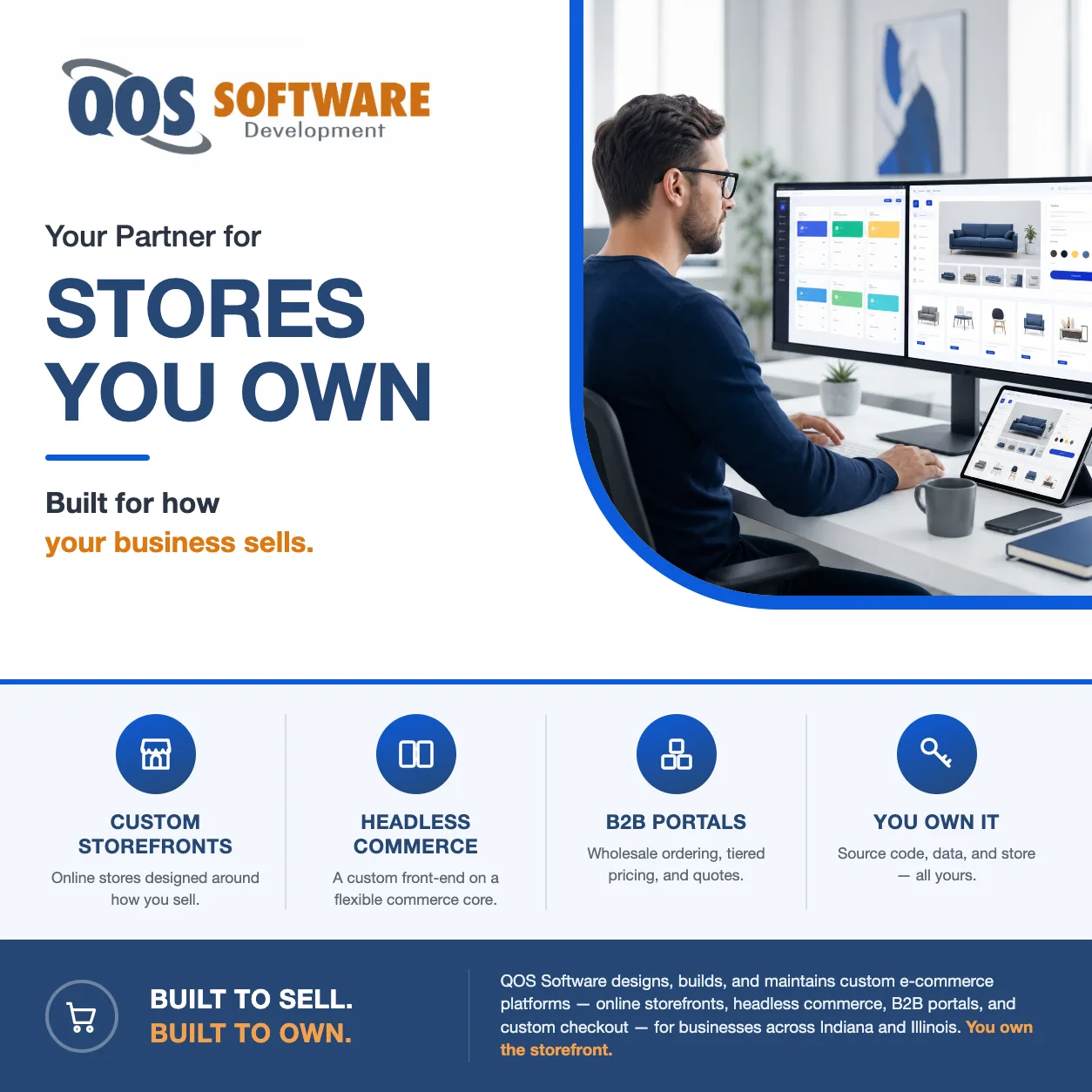
Custom e-commerce development is building an online store's storefront, checkout, and back-office as software the business owns, rather than renting a template on a hosted platform. A template store hands you a fixed catalog, checkout, and set of features and asks you to fit your business inside them; a custom build starts from how you sell and constructs the store to match. In short: with a platform you rent a storefront, and with a custom build you own one.
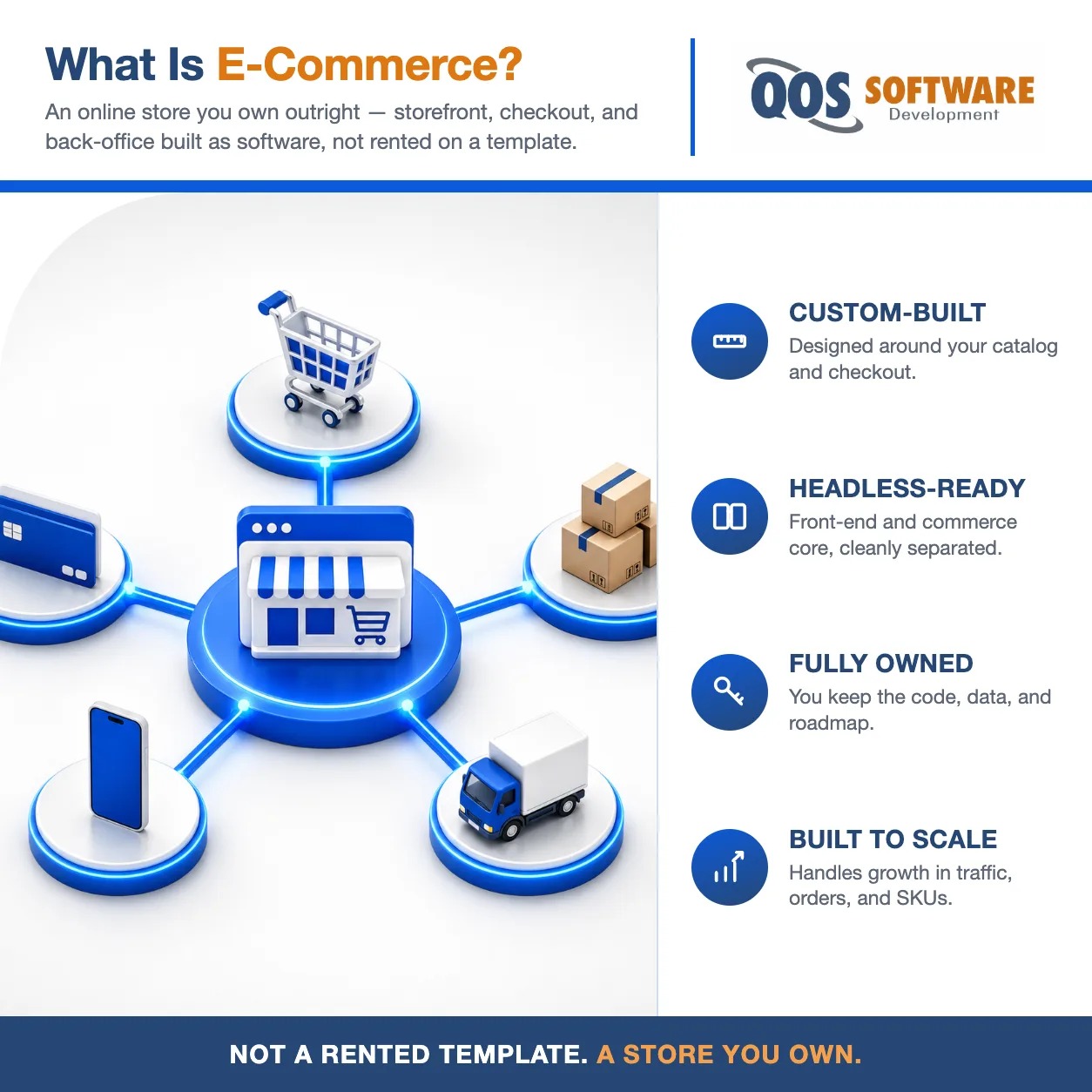
- A custom storefront front-end designed to your brand
- Headless commerce architecture across channels
- Payment gateway and checkout integration
- Custom checkout flows and business rules
- Product catalog and inventory sync
- Order management and fulfillment workflows
- B2B pricing, account roles, and quoting
- Marketplace and multi-vendor capability
Why Indianapolis Businesses Choose QOS Software
Plenty of shops can stand up a store. Fewer engineer commerce for a living, tell you when a platform is the right answer, and ship software you actually own.
- Commerce engineering — checkout, catalog, and fulfillment, not generic web work
- Honest platform guidance — we tell you when Shopify is the right answer
- AI-assisted development that ships faster and lowers cost
- A senior local team across both metros
An Online Store You Own Outright
The difference between building and renting is ownership. When we finish, the store is yours — not a subscription you paid us to create, and not a template you can be evicted from.
- The full storefront source code, outright
- All intellectual property and rights
- Your product, order, and customer data
- The checkout and payment configuration
- The product roadmap and release schedule
- The hosting and infrastructure of your choice
Custom E-Commerce vs. Off-the-Shelf Platforms: When Each Wins
Where a custom store earns its keep — and where Shopify is the smarter start.
| Factor | Custom E-Commerce Build | Shopify-Class Platform |
|---|---|---|
| Fit to your sales model | Built around how you sell — B2B tiers, quoting, and bundles included | You adapt your sales model to what the template supports |
| Ownership | You own the storefront source code, data, and roadmap | The platform owns the storefront; you rent access to it |
| Cost structure | One build investment, then hosting and maintenance you control | Ongoing platform and app subscription fees that climb as sales grow |
| Checkout & UX control | Checkout built for your flow and your conversion | Checkout limited to the platform's fixed options |
| Integration depth | Connects directly to the systems you already run | Integrates only where the platform and its apps allow |
Where We Build E-Commerce Platforms
We build online stores for businesses in two metros and ship to clients nationwide. Indianapolis and Central Indiana are home; the Chicago metro and Northern Illinois are our growing second market.
- Indianapolis and Central Indiana businesses
- Chicago metro and Northern Illinois companies
- Remote and on-site engagements across both states
- Nationwide clients who need a dedicated commerce partner
Download the E-Commerce Approach Checklist
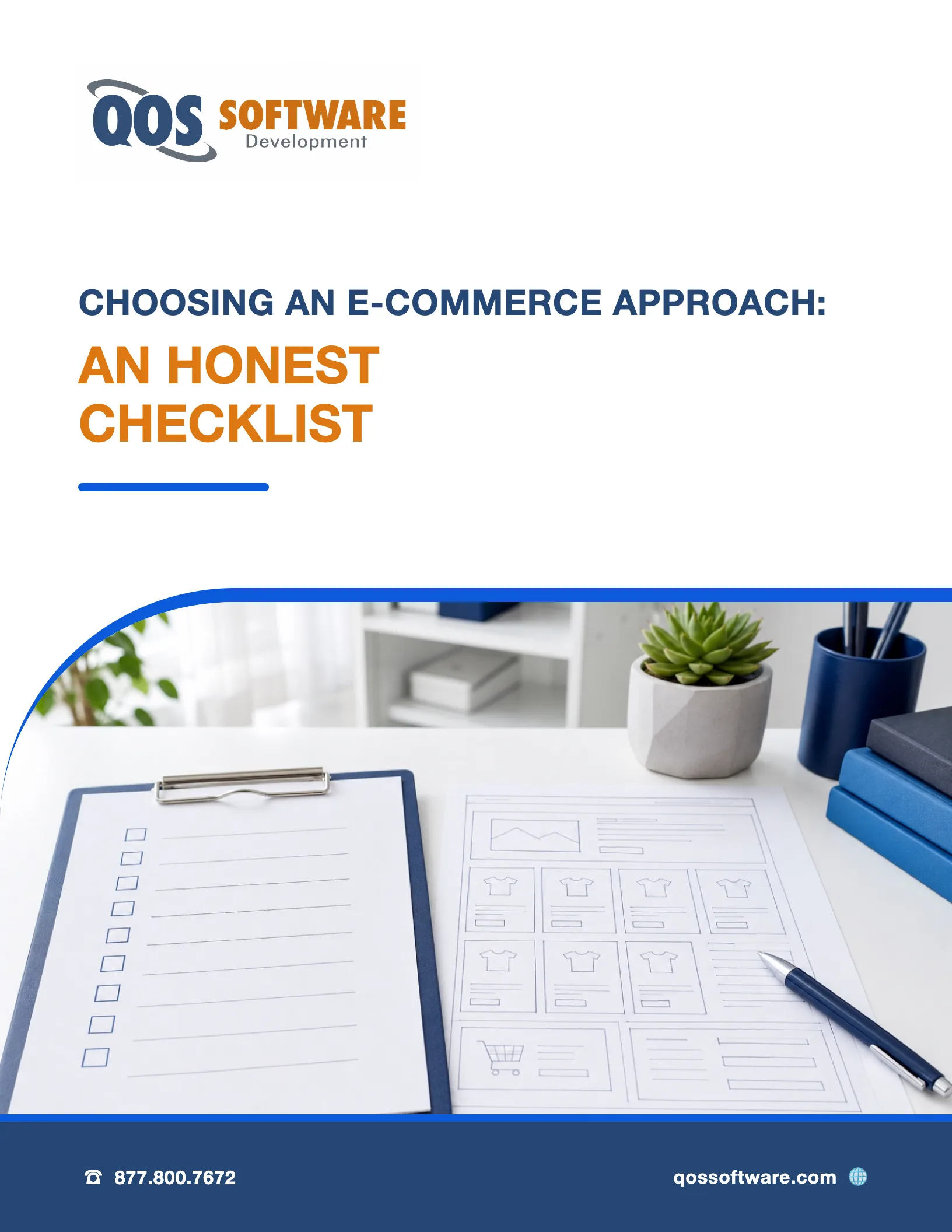
Before you commit to a platform or a custom build, a handful of questions decide which is right — how you sell, your catalog, B2B needs, checkout, integrations, migration risk, ownership, and what really drives cost. This free checklist walks you through them, so you choose your approach with eyes open and skip the expensive workarounds that come from picking wrong.
Frequently Asked Questions About E-Commerce Development
-
What is custom e-commerce development?
Custom e-commerce development means building an online store's storefront, checkout, and back-office as software your business owns outright, instead of renting a template on a hosted platform like Shopify. You get the source code, your data, and full control over how products, pricing, and checkout work, so the store fits how you actually sell rather than forcing your business into a template.
-
When is Shopify or BigCommerce the smarter choice than a custom online store?
Choose Shopify or BigCommerce when you sell a standard catalog through a standard checkout, speed to launch matters most, and an off-the-shelf template already fits your brand — a proven platform gets you selling quickly with little to maintain. A custom online store earns its cost when pricing or checkout is your competitive edge, when platform and app fees climb badly as sales grow, or when the store must integrate deeply with how your business runs. We tell you honestly which side you're on before you spend anything.
-
What is headless commerce?
Headless commerce is an architecture that separates an online store's front-end — what shoppers see and interact with — from the back-end commerce engine that manages products, carts, and orders, connecting the two through APIs. Going headless lets you build a fully custom storefront, reuse the same commerce back-end across a website, mobile app, and other channels, and change the shopping experience without re-platforming the whole store. It's most worthwhile when the shopping experience itself is a differentiator or you sell across several channels at once.
-
Can you migrate an existing online store to a new platform without losing SEO?
Yes. We migrate online stores to new platforms while protecting search rankings by mapping every existing URL to its new address, setting up 301 redirects, preserving titles and metadata, and carefully moving product, category, and customer data. The biggest SEO risks in a migration are broken URLs and lost redirects, so we plan the URL map before launch and verify redirects and indexing afterward — the goal is that shoppers and search engines land exactly where they expect.
-
Can a custom e-commerce site handle B2B and wholesale pricing?
Yes. A custom e-commerce site can handle full B2B and wholesale ordering — tiered and customer-specific pricing, account roles and permissions, quotes and approval workflows, purchase orders, and net terms — alongside or separate from your retail storefront. This is where custom builds pull ahead of off-the-shelf platforms, which usually model one price for one product and need workarounds or paid apps to support wholesale accounts and negotiated pricing.
-
Can you add AI product recommendations to an online store?
Yes, as a feature inside a store we build for you — we can integrate AI-driven product recommendations, search, and personalization into your storefront when you ask for them. What QOS Software does not do is sell standalone AI products; AI agents, automation, and LLM workflows are built by our sister company, QOS Agentic (qosagentic.com). If you want a dedicated AI product rather than a commerce feature, we'll point you to the right team.