Mobile App Development in Indianapolis
Mobile Apps We Build
Six kinds of mobile app we build for businesses across Indiana and Illinois.
Native iOS & Android Apps
Purpose-built apps for iPhone and Android that use each platform's hardware and speed to the fullest.
Cross-Platform Apps
One shared codebase that ships to both the App Store and Google Play for less.
Customer-Facing Apps
Branded apps your customers install to book, buy, and manage their account themselves.
Field & Workforce Apps
Apps for staff working in the field — offline-ready and built around the actual job.
App Modernization & Rescue
We take over, stabilize, and rebuild mobile apps that stalled or aged out.
App Backends & APIs
The backend your app runs on — data, user logins, and the integrations behind them.
When a Custom Mobile App Is Worth It — and When It Isn't
A custom mobile app is the right answer for some problems and an expensive mistake for others. Here's how we tell the difference — before you spend anything.
When you don't need an app
- A responsive web app already reaches your users
- A no-code builder covers the whole workflow
- Your audience won't install another app
- There's no offline or device-hardware need
When a custom app wins
- Your staff must work offline, out in the field
- You need the camera, GPS, or a barcode scanner
- Push notifications drive how you keep users engaged
- The app itself is the product you're selling
Mobile Apps Built Around How Your Business Actually Runs
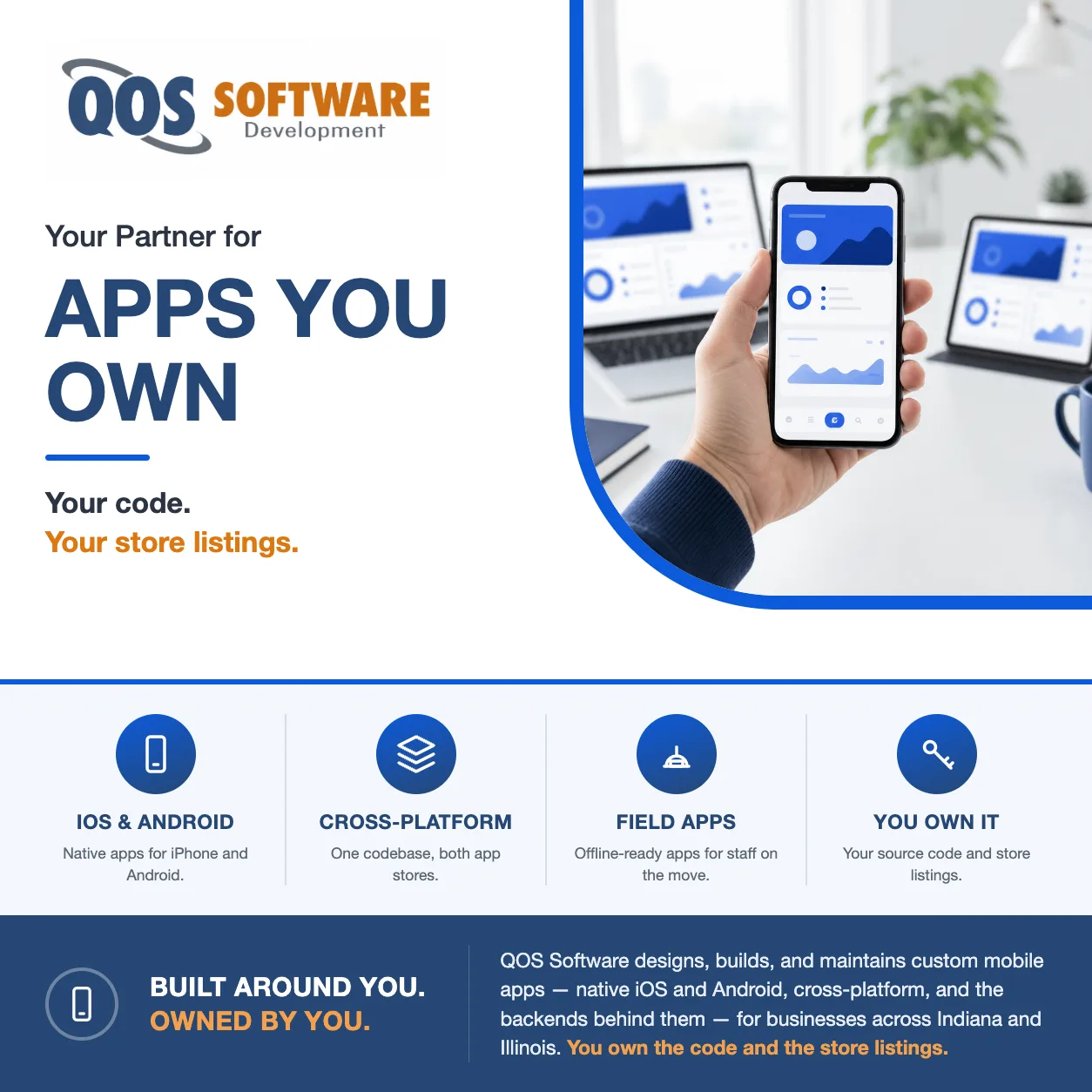
QOS Software builds custom mobile apps — native iOS and Android, cross-platform, and the backends behind them — for companies in Indianapolis, across Indiana, and in the Chicago metro. Every app ships with full ownership — source code and store listings under your own Apple and Google accounts.
A custom mobile app isn’t a shrunk-down website. It’s software your users install on their phone that does real work — offline in the field, using the camera or GPS, sending the push notification that brings them back. We build the app around how your business runs instead of forcing your work into a template.
Mobile app development is one focus of our broader custom software development practice. Whether you need a customer-facing app, a tool for your field crews, or a rescue of one that stalled, we scope it honestly first — and tell you when a mobile-friendly web app is the smarter buy.
Every project ships with the source code, the app published under your own Apple Developer and Google Play accounts, and your data in hand — so you can add features, change developers, or move on without starting over.
What Is Mobile App Development?
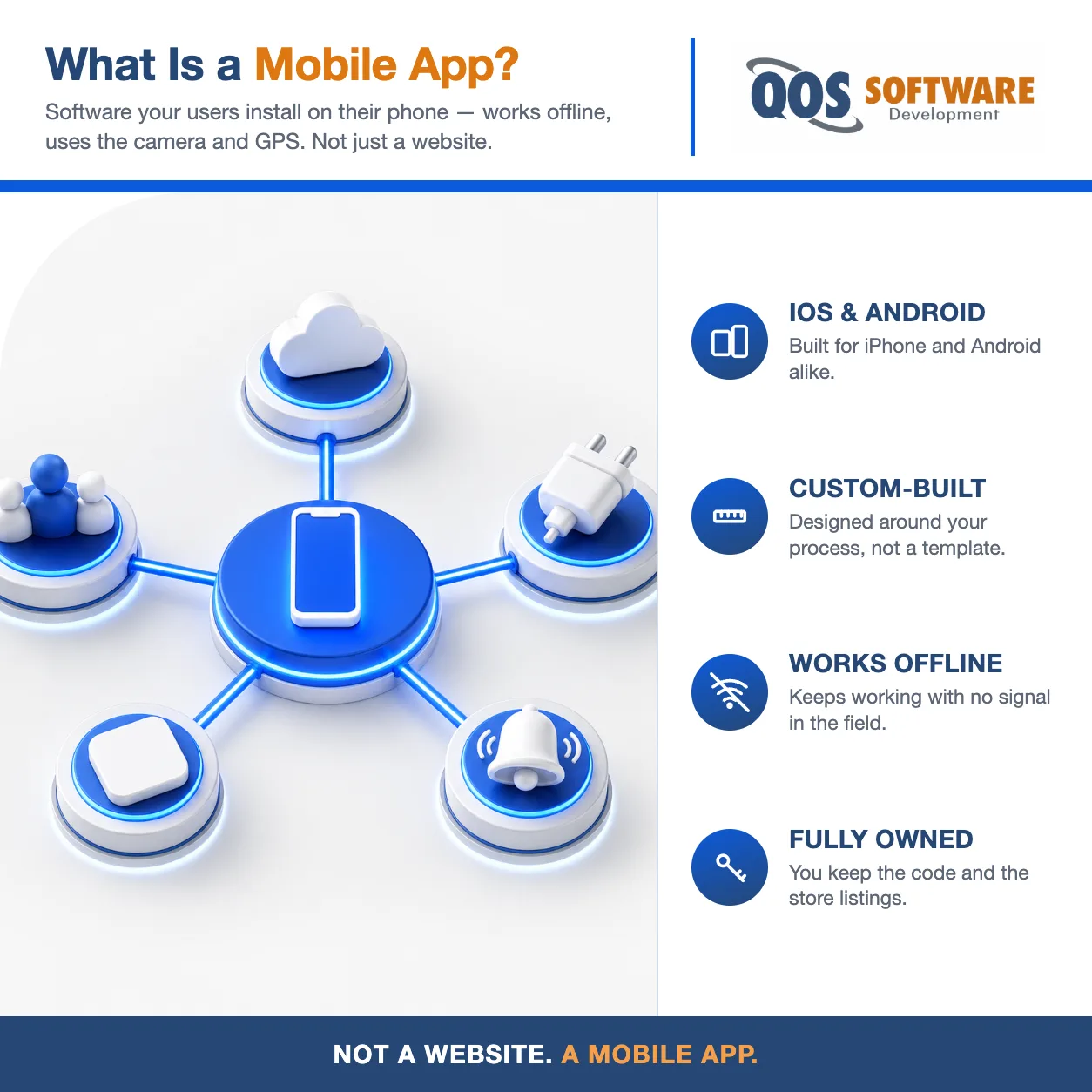
Mobile app development is the process of designing, building, and maintaining software that runs on smartphones and tablets — installed from the App Store or Google Play and built to use the device itself. A mobile app is not the same as a mobile-friendly website: a website adapts to a small screen in the browser, while an app is installed, works offline, and can reach the camera, GPS, and notifications. In short, a mobile-friendly site is something you visit, and a mobile app is something you install.
- Native iOS and Android development
- Cross-platform frameworks that share one codebase
- Offline data storage and sync
- Push notifications and in-app messaging
- Device hardware — camera, GPS, and barcode scanning
- App Store and Google Play deployment
- Mobile security and user authentication
- Analytics and crash monitoring
Why Indianapolis Businesses Choose QOS Software
Plenty of shops can ship an app. Fewer will tell you when not to build one, hand you an app you actually own, and still be there when Apple and Google change the rules next year.
- One team from design to App Store release — app and backend in-house
- You own the code and the store listings, under your own accounts
- AI-assisted development that ships faster and lowers cost
- Built for OS churn — updates as Apple and Google ship new versions
Software You Own
With mobile, ownership has a second trap most companies never see coming. Many agencies publish your app under their own Apple and Google accounts — so the listing is theirs to hold hostage. When we finish, the app and its store listings are yours.

- The full source code, outright
- Your Apple Developer account and listing
- Your Google Play account and listing
- Your data and the app's backend
- A documented handoff to any developer
- The freedom to leave anytime
Custom Mobile App vs. No-Code App Builder: When Each Wins
Where a custom app is worth it — and where a no-code builder already does the job.
| Factor | Custom Mobile App | No-Code App Builder |
|---|---|---|
| Fit | Built to match your exact workflow and brand | Fits simple, standard workflows the builder already supports |
| Ownership & portability | You own the source code and can move it to any developer | You rent the platform; the app lives inside the builder |
| App Store presence & control | Published under your own Apple and Google accounts | Often published under the builder’s account or a shared listing |
| Device features & offline use | Full access to camera, GPS, sensors, and offline mode | Limited to the device features the builder chooses to expose |
| Integration | Connects to the backend and systems you already run | Integrates only where the builder allows |
Where We Build Mobile Apps
We build mobile apps for businesses in two metros and ship to clients nationwide. Indianapolis and Central Indiana are home; the Chicago metro and Northern Illinois are our growing second market.
- Indianapolis and Central Indiana businesses
- Chicago metro and Northern Illinois companies
- Remote teams and on-site engagements across both states
- Nationwide clients who need a dedicated app partner
Download the Mobile App Planning Checklist
Before you commission a mobile app, there are a dozen questions worth answering — about who your users are, which platforms to build for, whether you need offline or device hardware, and who owns the developer accounts at the end. This free checklist walks you through them, so you plan the app clearly and skip the expensive surprises that come from not asking.
Frequently Asked Questions About Mobile App Development
-
What is the difference between a mobile app and a mobile-friendly website?
A mobile-friendly website adapts to a phone screen but still runs in the browser; a mobile app is installed from the App Store or Google Play and can work offline, use the camera and GPS, and send push notifications. If your users mainly need to read information or fill in a form, a mobile-friendly web app is usually enough. If they need to work offline or use the phone's hardware, that's when a native app earns its place.
-
Should I build a native app or a cross-platform app?
For most businesses, a cross-platform app is the right call — one codebase ships to both iPhone and Android for less time and money, and modern frameworks are fast enough for the vast majority of apps. Go native when you need the last bit of performance, deep hardware integration, or platform-specific features cross-platform can't reach. We tell you honestly which one your app actually needs, rather than defaulting to the more expensive build.
-
How long does it take to develop a mobile app?
Timelines run by scope, not a fixed number. A focused single-platform app can take a couple of months; a cross-platform app with a backend, several user roles, and integrations takes longer. The biggest drivers are how many features you need, whether you build for one platform or both, how much has to work offline, and how many outside systems you connect. We give you a schedule after scoping, not before.
-
Who owns the code and app store listings for a custom mobile app?
You do — outright. With QOS Software you own the source code, and the app is published under your own Apple Developer and Google Play accounts, in your company's name. That's the mobile trap most people miss: many agencies publish under their own accounts, which quietly locks you in. We hand you the code and the listings, so you can add features, change developers, or leave anytime.
-
Can you add AI features to a mobile app?
Yes. An AI feature your app needs — a recommendation engine, image recognition, an in-app assistant — is part of the app we build for you, and we use AI to assist development as well. What we don't sell is standalone AI products; AI agents and automation platforms are built by our sister company, QOS Agentic (qosagentic.com). If your project is really an AI product, we'll point you to the right team.
-
Can you take over, fix, or rebuild an existing mobile app?
Yes. We regularly take over mobile apps built by another team — reviewing the code, stabilizing what's there, and adding features from where it stands. If the app is too far gone, we rebuild it on a foundation you own, and move your store listings into your own Apple and Google accounts as part of the work. Either way, you keep ownership of the result.